Businesses in Jeddah need reliable processes to maintain product quality, meet customer expectations, and compete in growing markets. Saudi Arabia’s manufacturing sector recorded an 18% rise in business registrations, reaching 255,188 by the end of Q3 2026, according to Arab News.
This growth makes quality management increasingly relevant for companies. ISO 9001:2026 helps organisations improve processes, manage risks, and strengthen customer satisfaction. Global Quality Services guides businesses through gap assessments, documentation, and audit preparation. Hiring a consultant helps you interpret updated requirements and prepare your QMS for certification.
What is ISO 9001:2026 Certification?
ISO 9001:2026 is an international Quality Management System standard that helps organisations control their processes and maintain consistent quality. It gives businesses a structured way to manage activities, monitor performance, and improve customer satisfaction.
The International Organization for Standardization (ISO) released the sixth edition on 16 September 2026. This revision builds on ISO 9001:2015 and addresses evolving organisational needs. It also gives more attention to leadership involvement, ethical conduct, quality awareness, and effective decision-making.
ISO 9001 remains one of the most widely adopted management system standards worldwide. Businesses in Jeddah can use the latest edition to improve internal operations, manage customer expectations, and strengthen their approach to quality management.
Why Should Businesses in Jeddah Get ISO 9001:2026 Certified?
Jeddah has a diverse business environment with companies operating in manufacturing, logistics, construction, healthcare, retail, and other industries. These organisations must maintain dependable processes to serve customers and meet industry expectations.
ISO 9001:2026 helps businesses address these needs in several ways.
1. Maintain Consistent Quality Standards
Clear procedures help employees perform their tasks consistently. Businesses can monitor work quality, identify recurring defects, and take timely action to correct problems.
2. Strengthen Customer Relationships
Customers value businesses that deliver dependable products and services. Certification demonstrates that your organisation follows a recognised approach to quality management and customer satisfaction.
3. Make Daily Operations More Efficient
The standard encourages organisations to examine how their processes work. Businesses can identify unnecessary activities, reduce delays and improve the use of available resources.
4. Manage Business Risks Effectively
Unexpected problems can affect production, service delivery and customer commitments. ISO 9001:2026 encourages businesses to evaluate risks and opportunities and take appropriate action.
5. Improve Business Opportunities
Certification can strengthen your company’s credibility when dealing with potential clients, suppliers, and business partners. It also demonstrates your commitment to internationally recognised quality practices.
6. Develop a Strong Quality Culture
Quality improvement requires participation from the entire workforce. The revised standard encourages leadership involvement and greater employee awareness of quality responsibilities.
Step-by-Step Process to Obtain ISO 9001:2026 Certification in Jeddah
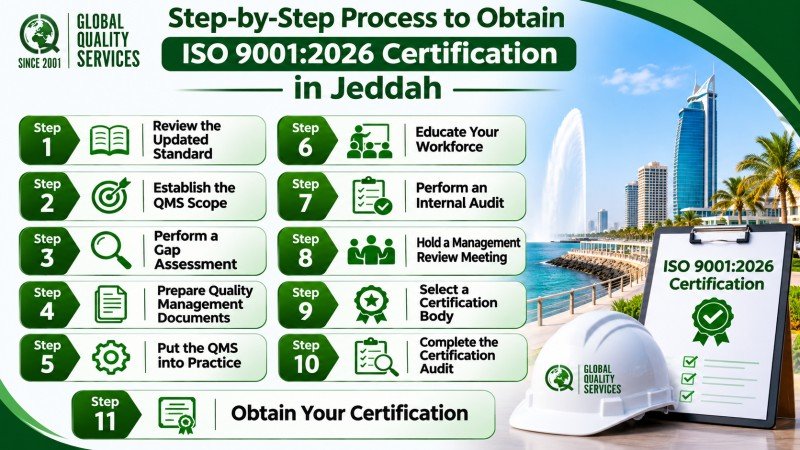
Getting ISO 9001:2026 certified involves several activities, from reviewing existing procedures to completing the external audit. Here is how your organisation can approach the process.
Step 1: Review the Updated Standard
Begin by studying the ISO 9001:2026 requirements. Understand the revised clauses and identify how they relate to your organisation’s activities, management responsibilities, and quality objectives.
Step 2: Establish the QMS Scope
Determine which business functions, departments, locations and services will fall under your Quality Management System. Consider your organisational activities and the expectations of relevant interested parties.
Step 3: Perform a Gap Assessment
Evaluate your current quality management practices against the revised requirements. Identify missing controls, outdated procedures, and operational issues that require attention before implementation.
Step 4: Prepare Quality Management Documents
Develop the necessary QMS documentation for your organisation. This may include quality policies, process guidelines, work instructions, quality objectives and supporting records.
Step 5: Put the QMS into Practice
Introduce the updated procedures across relevant departments. Allocate responsibilities, communicate process changes, and maintain records that demonstrate how your organisation manages quality activities.
Step 6: Educate Your Workforce
Arrange suitable training for employees, managers, and other relevant personnel. Explain their responsibilities and show how their daily activities contribute to quality objectives.
Step 7: Perform an Internal Audit
Check whether your organisation follows the documented procedures and meets the standard’s requirements. Record audit observations and correct identified issues before the external assessment.
Step 8: Hold a Management Review Meeting
Management should evaluate the overall performance of the QMS. Review audit findings, customer satisfaction, process performance, quality targets, and areas that require further improvement.
Step 9: Select a Certification Body
Choose an appropriate certification body and submit your application. The certification body will review your organisation’s readiness and arrange the required assessment activities.
Step 10: Complete the Certification Audit
Auditors will examine your QMS documentation, interview employees, and review operational practices. If they identify nonconformities, your organisation must investigate the causes and implement suitable corrective actions.
Step 11: Obtain Your Certification
After the certification body accepts the audit results and corrective action evidence, it makes the certification decision. Your organisation can then receive its ISO 9001:2026 certificate.
Benefits of ISO 9001:2026 Certification for Jeddah Businesses
Implementing the updated quality management standard can improve several areas of business performance. It helps organisations move beyond basic quality checks and develop better ways to manage their operations.
Key benefits include:
- Consistent service delivery: Standardised procedures help employees maintain the expected quality of products and services.
- Lower operational waste: Better process control can reduce repeated work, avoidable errors, and unnecessary expenses.
- Improved customer experience: Regularly reviewing customer feedback helps businesses identify service issues and respond more effectively.
- Stronger supplier relationships: Organisations can evaluate supplier performance and maintain clearer purchasing requirements.
- Clearer management responsibilities: Defined roles help managers and employees understand their quality-related duties.
- Better process visibility: Performance monitoring gives management useful information about operational results.
- Ongoing business improvement: Regular reviews and corrective actions help organisations address weaknesses and improve their QMS.
Why Choose Global Quality Services for ISO 9001:2026 Certification in Jeddah?
Preparing for a revised ISO standard can involve changes to existing documents, procedures, and employee responsibilities. Working with an experienced consultant can help your organisation handle these activities in an organised manner.
Global Quality Services supports businesses throughout their ISO 9001:2026 certification preparation. Our team focuses on understanding your existing processes and identifying the changes needed to meet the updated requirements.
Here is what we can assist you with:
- Initial QMS evaluation: We examine your existing quality management practices and identify areas that need revision.
- Gap assessment: Our consultants highlight differences between your current system and the latest ISO requirements.
- Documentation preparation: We assist with preparing and revising relevant quality management documents.
- Employee awareness sessions: We help your workforce understand the updated requirements and their responsibilities.
- Internal audit preparation: We guide your organisation through audit activities and corrective action planning.
- Certification audit assistance: We help your team prepare for the external assessment and address identified issues.
We focus on practical improvements that suit your organisation’s activities. We aim to help your business develop a QMS that supports daily operations and long-term quality objectives.
Contact Global Quality Services for ISO 9001:2026 Certification in Jeddah
Want to bring your quality management practices in line with ISO 9001:2026? Global Quality Services can guide your organisation through the preparation and certification process. From reviewing existing procedures to supporting internal audits, our consultants help your team address the updated requirements. Connect with Global Quality Services today to discuss your business needs and plan your ISO 9001:2026 certification journey.
Frequently Asked Questions
1. Is ISO 9001:2026 suitable for newly established companies in Jeddah?
Yes. Start-ups and newly established businesses can adopt ISO 9001:2026 from an early stage. It helps them establish clear processes and develop consistent quality practices.
2. Can ISO 9001:2026 support businesses working with international customers?
Yes. Certification demonstrates your commitment to recognised quality management practices. This can strengthen business relationships with international clients and potential partners.
3. What should a company do after receiving its ISO 9001:2026 certificate?
The company should continue monitoring its QMS, conducting internal audits, reviewing performance, and addressing nonconformities to maintain effective implementation.
4. Can different branches of a company operate under one ISO 9001:2026 certificate?
Yes, subject to the certification body’s eligibility and multi-site sampling requirements. The organisation must establish suitable central controls and demonstrate effective QMS implementation across the included locations.
5. What records should businesses maintain during ISO 9001:2026 implementation?
Businesses should retain relevant audit reports, training records, performance evaluations, corrective action records, customer feedback, and other documented information required by their QMS.