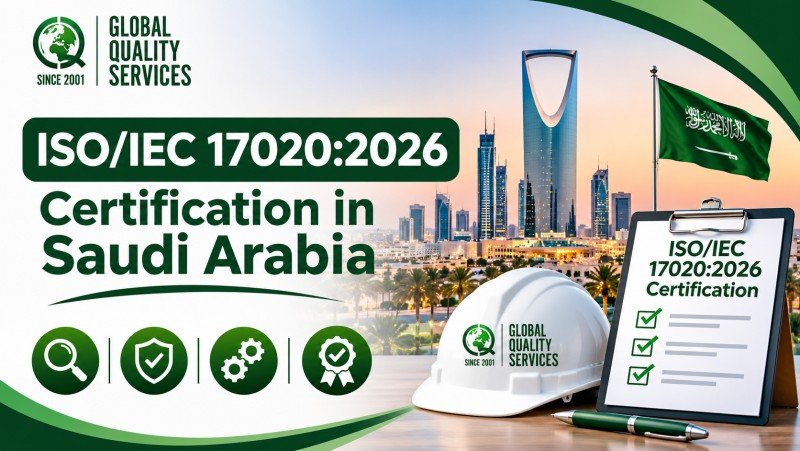
Inspection bodies in Saudi Arabia must demonstrate technical competence, impartiality, and consistent practices to earn regulatory and customer confidence. The Saudi Accreditation Center reported 1,000 accredited conformity assessment bodies across laboratories, inspection, and certification on August 30, 2026.
This milestone highlights the growing importance of credible inspection services. ISO/IEC 17020:2026 sets requirements for inspection body competence and impartiality. Global Quality Services helps organizations prepare their systems and teams for accreditation. Hiring a reputed consultant helps identify gaps, interpret requirements, and prepare for the SAAC assessment.
What is ISO/IEC 17020:2026 Accreditation?
ISO/IEC 17020:2026 is an international standard that specifies requirements for organizations performing inspection activities. It focuses on three important areas: technical competence, impartiality, and consistent inspection operations.
The International Organization for Standardization (ISO) and the International Electrotechnical Commission (IEC) published the third edition on March 27, 2026. It replaces the 2012 edition and addresses changes in inspection practices, organizational responsibilities, and information management.
The standard applies to organizations that examine products, materials, equipment, installations, plants, processes, work procedures, and services. Inspection bodies use it to demonstrate that qualified personnel perform inspections through suitable methods and objective decision-making.
In Saudi Arabia, the Saudi Accreditation Center assesses inspection bodies against ISO/IEC 17020 requirements. SAAC evaluates their technical and managerial competence within specific inspection scopes.
For example, an inspection company that examines industrial facilities must demonstrate that its inspectors have suitable technical knowledge, follow approved inspection procedures, and report findings accurately.
Why is ISO/IEC 17020:2026 Accreditation Important in Saudi Arabia?
Saudi Arabia has inspection requirements across several sectors, including construction, manufacturing, transportation, industrial facilities, food, safety, and environmental services. Inspection bodies must demonstrate that their work meets defined technical and operational requirements.
ISO/IEC 17020:2026 gives these organizations a recognized basis for demonstrating their competence.
1. Establish Technical Competence
Inspection bodies must show that their personnel can perform assigned inspection activities correctly. The standard addresses qualifications, experience, training, authorization, and technical knowledge.
2. Maintain Impartial Inspection Decisions
Customers and regulators expect inspection findings without commercial or personal influence. The standard requires organizations to identify threats to impartiality and take appropriate action.
3. Strengthen Customer Confidence
Accreditation gives clients independent evidence that an inspection body meets applicable competence and operational requirements. This can strengthen business relationships with manufacturers, contractors, project owners, and government organizations.
4. Improve Inspection Consistency
Approved methods, clear responsibilities, controlled equipment, and proper reporting help inspectors follow consistent practices. These controls also make inspection results easier to review and verify.
5. Support Regulatory and Industry Requirements
Certain industries and regulatory schemes require inspection bodies to hold accreditation for specific activities. SAAC provides accreditation across areas such as industrial facilities, equipment, roads, vehicles, safety, and logistics.
6. Strengthen Data and Information Control
The 2026 edition gives greater attention to data and information control. Inspection bodies must consider how they manage digital records, electronic reports, inspection software, and other information used during inspection activities.
7. Improve International Recognition
Accreditation can strengthen confidence in inspection results among customers, authorities, and business partners. It also supports the wider acceptance of conformity assessment results through recognized accreditation arrangements.
Who Needs ISO/IEC 17020:2026 Accreditation in Saudi Arabia?
Organizations that perform inspection activities and want independent recognition of their technical competence may need ISO/IEC 17020:2026 accreditation.
The Saudi Accreditation Center identifies several inspection areas under its accreditation service.
These include:
- Equipment inspection companies
- Building inspection bodies
- Industrial facility inspection providers
- Road inspection organizations
- Vehicle and truck inspection centers
- Legal metrology inspection bodies
- Safety inspection companies
- Elevator and escalator inspection providers
- Logistics inspection organizations
- Food and drug inspection bodies
- Environmental inspection organizations
- Tourism inspection providers
- Communications and information technology inspection bodies
- Nuclear radiation inspection organizations
The required accreditation scope depends on the inspection activities your organization performs. You should define the scope carefully before applying to SAAC.
Key Requirements of ISO/IEC 17020:2026
An inspection body must establish effective technical and management controls before applying for accreditation. The standard covers several areas that directly affect inspection activities.
1. Impartiality and Independence
Your organization must identify relationships or business interests that could influence inspection decisions. It must assess impartiality risks and establish suitable controls.
2. Confidentiality
Inspection bodies must protect information received or generated during their activities. They should control access to client information, inspection reports, and confidential records.
3. Organizational Structure and Responsibilities
The organization must define its management structure, technical responsibilities, and reporting arrangements. Employees should understand their authority and duties during inspection activities.
4. Personnel Competence
Inspectors must have suitable qualifications, experience, technical knowledge, and training. Management must assess their competence and authorize them for relevant inspection activities.
5. Inspection Methods and Procedures
Inspection bodies must use suitable methods for their defined scope. They must document inspection procedures, control method changes, and maintain records of inspection activities.
6. Equipment and Technical Resources
Organizations must use suitable equipment and maintain it in proper working condition. They should address calibration, verification, maintenance, and equipment identification where applicable.
7. Inspection Records and Reports
Inspection bodies must maintain accurate records that support their findings. Reports should identify the inspected item, applicable requirements, inspection results, and relevant conclusions.
8. Complaints and Appeals
Your organization must establish arrangements for receiving, reviewing, and resolving complaints and appeals. These procedures should support fair handling and documented decisions.
9. Management System Requirements
Inspection bodies must establish management controls that support consistent operations. These include document control, internal audits, management reviews, corrective actions, and continual improvement.
10. Data and Information Management
The revised edition addresses information control more directly. Organizations must protect inspection data, control relevant information systems, and maintain the accuracy and availability of records.
Step-by-Step Process to Get ISO/IEC 17020:2026 Accreditation in Saudi Arabia
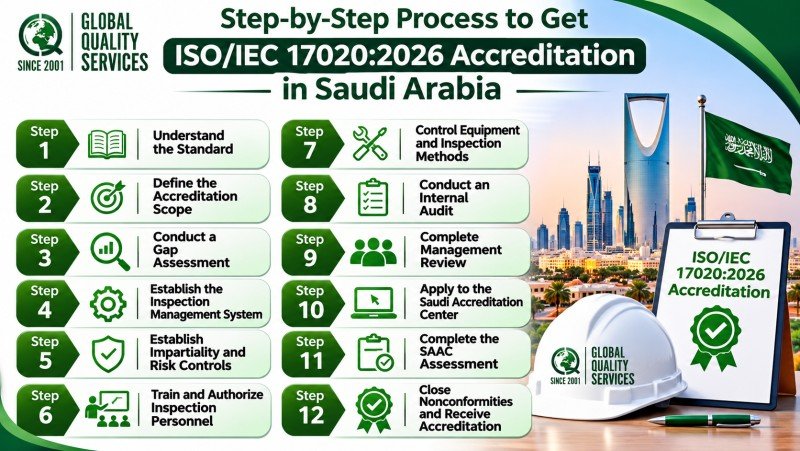
Obtaining accreditation requires more than preparing documents. Your inspection body must demonstrate that qualified personnel, suitable equipment, and controlled procedures support its actual inspection activities.
Here is how your organization can prepare.
Step 1: Understand the Standard
Study the ISO/IEC 17020:2026 requirements and identify how they apply to your inspection activities. Review the changes from the 2012 edition and understand the applicable SAAC accreditation requirements.
Step 2: Define the Accreditation Scope
List the inspection activities for which your organization seeks accreditation. Identify the relevant inspection categories, technical areas, locations, and services. Make sure the proposed scope reflects your actual capabilities.
Step 3: Conduct a Gap Assessment
Compare your existing inspection arrangements with the latest standard. Review personnel competence, impartiality controls, inspection procedures, equipment, records, and management practices. Record the areas that need attention.
Step 4: Establish the Inspection Management System
Develop the management arrangements required for your inspection activities. Define responsibilities, reporting lines, operational controls, and procedures for handling inspection work.
Step 5: Establish Impartiality and Risk Controls
Identify financial, commercial, organizational, and personal relationships that could affect inspection decisions. Assess relevant risks and establish controls to protect the objectivity of your inspection results.
Step 6: Train and Authorize Inspection Personnel
Review the qualifications and experience of your inspectors. Provide relevant training and assess their technical competence. Maintain authorization records for the inspection activities they perform.
Step 7: Control Equipment and Inspection Methods
Identify the equipment required for each inspection activity. Establish suitable maintenance, calibration, and verification arrangements. Document inspection methods and confirm that employees follow the approved procedures.
Step 8: Conduct an Internal Audit
Review the implemented system against ISO/IEC 17020:2026 requirements. Check inspection records, personnel authorization, impartiality controls, equipment records, and reporting practices. Address any findings before applying.
Step 9: Complete Management Review
Management should evaluate the inspection body’s performance and readiness. Review audit results, complaints, appeals, customer feedback, risks, resource requirements, and improvement actions.
Step 10: Apply to the Saudi Accreditation Center
Submit your application through the SAAC accreditation portal. Provide the required commercial registration, insurance coverage, technical documents, and administrative information.
Step 11: Complete the SAAC Assessment
SAAC reviews the application and supporting documents. Its assessors conduct an on-site assessment to evaluate your organization’s technical competence and implementation of the standard.
Step 12: Close Nonconformities and Receive Accreditation
Address any nonconformities raised during the assessment. Investigate their causes, implement corrective actions, and submit supporting evidence. SAAC reviews the findings before making its accreditation decision.
What Changes in ISO/IEC 17020:2026?
The 2026 edition introduces several changes that inspection bodies should address when establishing or updating their management systems.
The main changes include:
- Revised independence classification: The standard replaces the previous Type A, Type B, and Type C classification with Type A and Type non-A.
- Risk-based thinking: It gives organizations greater flexibility to identify and address risks and opportunities affecting inspection activities.
- Data and information control: It introduces clearer provisions for managing information used during inspection work.
- More flexible management requirements: It allows greater flexibility in how inspection bodies manage procedures, documented information, and organizational responsibilities.
- Updated terminology: The revised edition introduces definitions for terms such as item and client.
Inspection bodies accredited to ISO/IEC 17020:2012 should review these changes before planning their transition. The transition period runs for three years from publication, with March 27, 2029, as the stated deadline.
ISO/IEC 17020:2026 Accreditation Requirements of the Saudi Accreditation Center
The Saudi Accreditation Center (SAAC) serves as Saudi Arabia’s national accreditation body. It assesses inspection bodies to determine whether they have the technical and managerial competence required for their declared inspection activities.
SAAC offers inspection body accreditation across several areas, including:
- Equipment
- Saudi Building Code
- Systems and industrial facilities
- Roads
- Vehicles and trucks
- Legal metrology
- Safety
- Elevators and escalators
- Logistics services
- Food and drug
- Environment
- Tourism
- Communications and information technology
- Nuclear radiation
- How Does SAAC Evaluate Inspection Bodies?
The accreditation process involves several assessment stages.
- Application: The inspection body submits its accreditation application through the SAAC portal.
- Application review: SAAC checks the application and verifies whether the organization has submitted the required information.
- Document review: Assessors examine the technical and management documents against applicable requirements.
- On-site assessment: SAAC evaluates the organization’s actual inspection activities, personnel, facilities, and technical arrangements.
- Corrective actions: The organization addresses nonconformities identified during the assessment.
- Accreditation decision: SAAC reviews the assessment results and decides whether the inspection body meets the accreditation requirements.
SAAC currently lists 85 working days as the completion duration for its inspection body accreditation service. However, actual timelines depend on the accreditation scope, organizational readiness, assessment requirements, and closure of nonconformities.
Benefits of ISO/IEC 17020:2026 Accreditation for Inspection Bodies
Accreditation can strengthen your organization’s position when customers, regulators, and business partners need dependable inspection results.
Here are the main business benefits.
- Stronger market credibility: Demonstrate that your inspection body meets internationally recognized competence requirements.
- Greater customer trust: Give customers independent evidence of your inspection capabilities.
- Improved technical performance: Maintain qualified inspectors, suitable equipment, and controlled inspection methods.
- Objective inspection results: Establish controls that protect inspection decisions from conflicts of interest.
- Better operational control: Maintain clear responsibilities, approved procedures, and reliable inspection records.
- Improved regulatory confidence: Demonstrate conformity with relevant accreditation and technical requirements.
- Better tender opportunities: Strengthen your credentials when clients require accredited inspection services.
- International acceptance: Support confidence in inspection results through recognized accreditation arrangements.
- Reduced inspection errors: Improve technical controls and address problems through corrective actions.
- Clearer accountability: Maintain traceable records of inspection activities, findings, and decisions.
Why Choose Global Quality Services for ISO/IEC 17020:2026 Accreditation in Saudi Arabia?
Choosing a reputed consultant can make a significant difference to your accreditation preparation. Inspection bodies need technical guidance, experienced management system consultants, and practical support that reflects their actual inspection activities.
Global Quality Services is a Singapore-based management consultancy that supports organizations with international standards, accreditation preparation, compliance assessments, and professional training.
The company has dedicated consultancy coverage for ISO/IEC 17020:2026. Its consultants help inspection organizations understand the standard, review existing arrangements, and prepare for assessment by the relevant accreditation body.
Global Quality Services also brings a wider background in quality management, technical compliance, and inspection-related consulting. Its website reports 1,450 happy customers, operations across 17 locations, 1,200 training programs, and 21 years of experience.
Global Quality Services focuses on helping inspection bodies build systems that work in their actual business environment. We do not treat accreditation as a paperwork exercise. Our consultants consider your inspection scope, personnel, technical resources, impartiality arrangements, and reporting practices. Formal accreditation remains the responsibility of SAAC. Global Quality Services supports your organization throughout preparation and assessment readiness.
Get ISO/IEC 17020:2026 Accreditation Support in Saudi Arabia from Global Quality Services
Are you planning to establish an accredited inspection body or transition your existing accreditation to ISO/IEC 17020:2026? Work with Global Quality Services to prepare your organization for the requirements of the Saudi Accreditation Center.
Our consultants can help you review your inspection scope, assess existing practices, develop documentation, strengthen impartiality controls, and prepare your team for the assessment. Do not leave accreditation preparation until an assessment deadline approaches. Discuss your requirements with Global Quality Services and get a clear understanding of the work involved.
Frequently Asked Questions
1. What is the difference between ISO/IEC 17020:2026 accreditation and ISO 9001 certification?
ISO/IEC 17020:2026 applies to inspection bodies and evaluates their technical competence and impartiality. ISO 9001 evaluates an organization’s Quality Management System.
2. Can an in-house inspection department apply for ISO/IEC 17020:2026 accreditation?
Yes. In-house inspection departments can apply when their activities meet SAAC requirements. They must demonstrate suitable independence, competence, impartiality, and controls for their proposed inspection scope.
3. What documents does SAAC require from inspection bodies?
SAAC lists commercial registration, insurance coverage, and technical and administrative documents among its application requirements. Additional evidence depends on the proposed accreditation scope.
4. Can an inspection body outsource part of its inspection activities?
The standard places specific controls on externally provided inspection activities. Inspection bodies must demonstrate their competence and responsibility for outsourced work. They should review the applicable requirements before making outsourcing arrangements.
5. How long does ISO/IEC 17020:2026 accreditation remain valid in Saudi Arabia?
The applicable accreditation validity and surveillance arrangements follow SAAC regulations. Accredited bodies must meet ongoing assessment and surveillance requirements to maintain their accreditation status.
6. What happens if SAAC identifies nonconformities during its assessment?
The inspection body must investigate the findings, identify their causes, and implement corrective actions. SAAC reviews the submitted evidence before deciding whether the organization meets the accreditation requirements.
7. Can an inspection body expand its accreditation scope later?
Yes. An accredited inspection body can apply to SAAC for scope expansion. The center reviews the additional inspection activities and determines the assessment required.