What is ISO 9001:2026 Certification
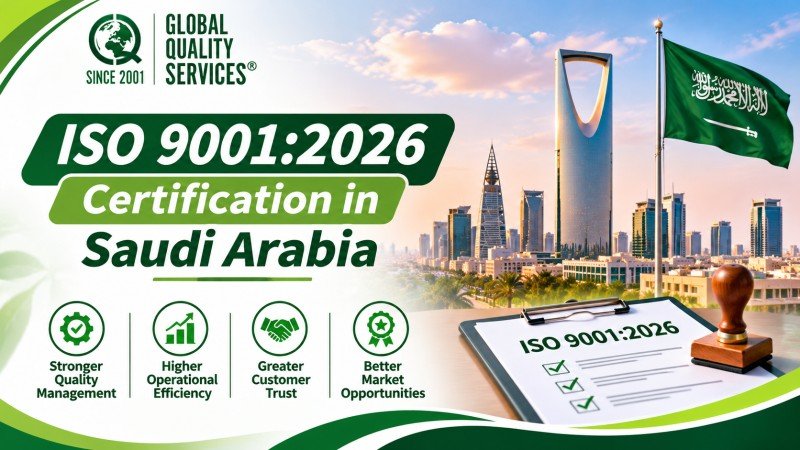
ISO 9001:2026 is the latest edition of the international Quality Management System standard published by the International Organization for Standardization (ISO) on 16 September 2026. It replaces ISO 9001:2015 and helps organizations manage quality across their operations.
The standard gives businesses a structured approach to controlling processes, understanding customer expectations and improving product or service quality. It applies to organizations of all sizes and industries, including manufacturing, construction, healthcare, logistics, IT and professional services.
The 2026 edition retains the familiar structure of the previous standard while introducing important updates. These include:
- Quality culture and ethical behaviour: Greater attention to shared values, responsible practices and employee involvement in quality management.
- Leadership accountability: Stronger emphasis on management responsibility and active participation in quality objectives.
- Risks and opportunities: Clearer separation between identifying risks and recognizing opportunities for business improvement.
- Change management: Greater attention to planning and managing changes that can affect QMS performance.
- Updated Annex A: Additional explanations help organizations understand the requirements and apply them correctly.
- Improved alignment: The updated Harmonized Structure makes integration with other ISO management system standards easier.
Organizations can implement ISO 9001:2026 without seeking certification. However, independent certification gives customers and business partners external evidence that your QMS meets the standard’s requirements.
Why is ISO 9001:2026 Certification Important for Businesses in Saudi Arabia?
Saudi Arabia has a diverse business environment covering manufacturing, construction, energy, healthcare, transportation, and technology. Companies working across these sectors must maintain consistent quality to meet customer expectations and compete for business opportunities.
ISO 9001:2026 helps businesses establish consistent working practices instead of depending on individual employees or informal procedures.
Here is why the latest certification matters:
- Meet changing customer expectations
- Customers expect businesses to deliver products and services according to agreed specifications. ISO 9001:2026 helps organizations understand these expectations and translate them into practical quality requirements.
- Strengthen supplier relationships
- Large organizations often assess suppliers before awarding contracts. A recognized QMS certification can strengthen your business profile and demonstrate your commitment to quality.
- Improve operational accountability
- When employees understand their responsibilities, teams can manage daily activities more effectively. The updated standard also places greater emphasis on leadership and quality culture.
- Prepare for business expansion
- Companies entering new markets need reliable processes that support consistent delivery. ISO 9001:2026 helps businesses establish quality practices that can support their expansion plans.
- Manage operational changes
- New technologies, suppliers, equipment, and customer requirements can affect product and service quality. The standard encourages businesses to assess and manage these changes before they disrupt operations.
- Stay aligned with the latest standard
- Businesses holding ISO 9001:2015 certification must prepare for the revised edition. Starting early gives your team more time to understand the changes and update existing procedures.
Benefits of ISO 9001:2026 Certification in Saudi Arabia
ISO 9001:2026 certification offers benefits beyond displaying an internationally recognized certificate. It helps businesses improve how they manage daily operations, monitor performance and respond to customer requirements.
Here are some important benefits:
1. Better Control Over Business Operations
A well-maintained QMS helps employees follow approved procedures. It also allows managers to identify process gaps, monitor performance, and address recurring problems.
2. Higher Customer Satisfaction
When businesses understand customer requirements, they can reduce service errors and improve delivery consistency. This helps build stronger customer relationships and encourages repeat business.
3. Improved Employee Accountability
The updated standard gives greater importance to leadership and quality culture. Employees understand their responsibilities and become more involved in maintaining quality across departments.
4. Reduced Operational Waste
Poor processes often lead to rework, rejected products, unnecessary expenses and delays. A structured QMS helps businesses identify these problems and make better use of available resources.
5. Stronger Business Credibility
An ISO 9001:2026 certificate from an accredited certification body gives customers and business partners confidence in your quality management practices. It can also strengthen your position during supplier evaluations and tender submissions.
6. Better Decision-Making
Businesses can use performance data, customer feedback, audit findings, and process results to make informed decisions. This helps management focus on areas that need attention.
7. Easier Integration With Other ISO Standards
The updated Harmonized Structure supports integration with standards such as ISO 14001 and ISO 45001. Businesses can manage multiple management systems more efficiently.
Step-by-Step Process to Get ISO 9001:2026 Certification in Saudi Arabia
Getting ISO 9001:2026 certified requires proper planning, employee participation, and an effective quality management system. Businesses should understand the standard before making changes to their existing processes.
Here is how the certification process works:
Step 1: Understand Your Business Requirements
Start by reviewing your business activities, organizational structure, products, and services. Identify the departments and processes that fall within your proposed certification scope. This helps determine how the standard applies to your operations.
Step 2: Conduct a Gap Analysis
Compare your existing quality management practices with ISO 9001:2026 requirements. Identify missing procedures, outdated documents, unclear responsibilities, and areas that need improvement. A gap analysis helps you prepare a practical implementation plan.
Step 3: Develop and Update QMS Documentation
Prepare the documented information your organization needs to manage quality effectively. This may include quality policies, objectives, process records, operational procedures, and monitoring methods. Keep the documentation relevant to your actual business activities.
Step 4: Implement the Quality Management System
Put the updated procedures into practice across relevant departments. Assign responsibilities to process owners and communicate the new requirements to employees. Management should actively monitor implementation and address any operational difficulties.
Step 5: Conduct Employee Training
Train employees according to their responsibilities within the QMS. Explain the updated requirements, quality objectives, and relevant procedures. Give internal auditors additional training so they can assess the system against ISO 9001:2026 requirements.
Step 6: Perform an Internal Audit
Conduct an internal audit to check whether your QMS meets the standard’s requirements. Review process records, employee awareness, and operational practices. Record any nonconformities and assign corrective actions to the responsible departments.
Step 7: Conduct Management Review
Top management should evaluate the QMS and review its performance. Discuss audit findings, customer feedback, quality objectives, process performance, risks, and opportunities. Record decisions and assign responsibilities for further improvements.
Step 8: Complete the Certification Audit
Select an accredited certification body to conduct an independent assessment of your QMS.
The certification audit generally takes place in two stages:
- Stage 1 Audit: The auditor reviews your QMS documentation, certification scope and readiness for the main assessment.
- Stage 2 Audit: The auditor evaluates how effectively your organization implements the system and meets ISO 9001:2026 requirements.
If the auditor identifies nonconformities, your organization must address them within the agreed timeframe.
Step 9: Receive Your ISO 9001:2026 Certificate
Once your organization meets the certification requirements and the certification body completes its review, it can issue your ISO 9001:2026 certificate.
ISO 9001:2015 to ISO 9001:2026 Transition Requirements
If your business already holds ISO 9001:2015 certification, you do not need to build a completely new quality management system. You can use your existing QMS as a starting point and update it according to the revised requirements.
The Global Accreditation Cooperation Incorporated (Global ACI) has established a three-year transition period for organizations moving to ISO 9001:2026.
Important transition dates include:
|
Transition milestone |
Deadline |
|---|---|
| Accreditation bodies ready to assess the new edition | 31 March 2027 |
| Certification bodies submit transition declarations | 30 June 2027 |
| Accreditation body transition decisions | 30 September 2027 |
| New initial accredited certifications must use ISO 9001:2026 | 31 March 2028 |
| Final deadline for existing ISO 9001:2015 certificates | 30 September 2029 |
Existing certified organizations must complete their transition by 30 September 2029. They can arrange the assessment during a scheduled surveillance audit, recertification audit or a separate transition audit, subject to their certification body’s arrangements.
What should Saudi Arabian businesses do now?
- Review the differences between ISO 9001:2015 and ISO 9001:2026.
- Check whether existing quality policies and procedures need updates.
- Assess how leadership and employees support a quality culture.
- Review how the organization identifies risks and opportunities.
- Update internal audit checklists and employee training materials.
- Discuss the transition schedule with your certification body.
Starting early can help your organization avoid last-minute documentation changes and audit preparation challenges.
Why Choose Global Quality Services for ISO 9001:2026 Certification in Saudi Arabia
Choosing the right consulting partner can significantly improve your certification experience. You need a team that understands your business operations, clearly explains the standard, and helps your employees follow the requirements.
- Global Quality Services (GQS) supports organizations through the different stages of ISO 9001:2026 implementation and certification preparation.
- Here is how our consultants can assist your business:
- Industry-focused consultation: We understand that manufacturing, construction, healthcare, and service businesses have different quality requirements. Our consultants consider your operations while planning the QMS.
- Gap analysis support: We assess your existing quality management practices and identify areas that require attention under ISO 9001:2026.
- Documentation assistance: Our team helps prepare and update relevant QMS documents, policies, procedures, and records according to your business requirements.
- Employee training: We help your employees understand their responsibilities and follow the updated quality management practices.
- Internal audit assistance: Our consultants help your team prepare for internal audits, identify nonconformities, and take appropriate corrective actions.
- Certification audit preparation: We guide your organization through audit preparation and help you understand the certification body’s assessment requirements.
Whether you are applying for ISO 9001 certification for the first time or transitioning from the 2015 edition, GQS can support your organization throughout the process.
Choose Global Quality Services for ISO 9001:2026 Certification in Saudi Arabia
Looking to achieve ISO 9001:2026 Certification in Saudi Arabia? Partner with Global Quality Services to make your certification journey simpler. Our consultants help you identify gaps, update QMS documentation, train employees, and prepare for certification audits. Whether you are seeking initial certification or transitioning from ISO 9001:2015, contact GQS today to discuss your requirements and take the next step. Contact Global Quality Services today for smooth and reliable service.
Frequently Asked Questions
1. Can a company with multiple branches in Saudi Arabia obtain one ISO 9001:2026 certificate?
Yes. A company can include multiple locations within one certification scope if they operate under an eligible management system and meet the certification body’s sampling and audit requirements.
2. Does ISO 9001:2026 certification require a dedicated quality manager?
No. The standard does not require a specific job title. However, management must assign clear responsibilities and authority for maintaining and monitoring the quality management system.
3. Can a small business in Saudi Arabia apply for ISO 9001:2026 certification?
Yes. Small businesses can apply regardless of employee numbers or annual turnover. They must define an appropriate QMS scope and demonstrate conformity with applicable requirements.
4. What happens if an auditor identifies a major nonconformity?
The organization must investigate the issue, identify its root cause, and implement corrective action. The certification body reviews the evidence before making its certification decision.
5. Can a company change its certification body during the ISO 9001:2026 transition?
Yes. An organization can transfer its certification to another eligible certification body. The new body reviews the existing certificate, audit history, and outstanding issues before accepting the transfer.