What is ISO 9001:2026 Certification?
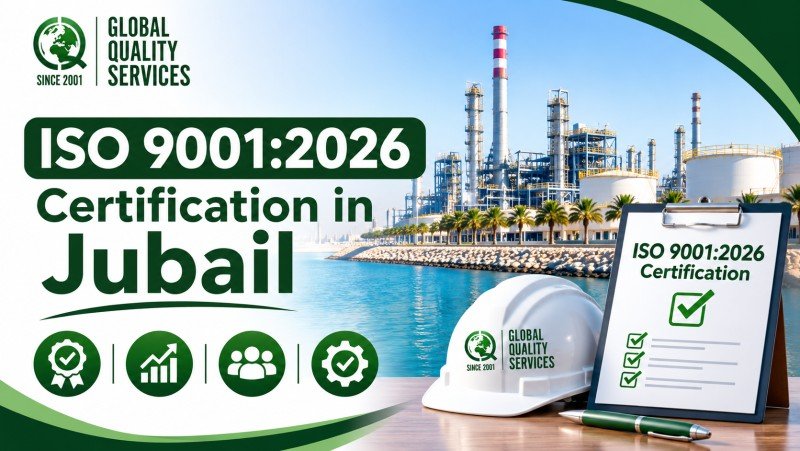
ISO 9001:2026 is the latest edition of the international Quality Management System (QMS) standard. It sets requirements that help organizations control their processes, meet customer expectations, and maintain consistent product and service quality.
The International Organization for Standardization (ISO) published this sixth edition on September 16, 2026. It builds on the previous edition and brings greater clarity to quality management requirements. The updated standard places stronger attention on leadership, quality culture, ethical behavior, and the management of risks and opportunities.
For businesses in Jubail, ISO 9001:2026 offers a practical way to bring different departments under consistent quality controls. It helps management understand how work gets done, where errors occur, and what needs attention.
Certification also gives customers, procurement teams, and business partners independent evidence that your organization meets the applicable ISO 9001 requirements. An accredited certification body conducts the certification audit and makes the certification decision. Global Quality Services supports your organization with consultancy, implementation, training, and audit preparation.
Why is ISO 9001:2026 Certification Important for Businesses in Jubail?
Jubail has a major industrial base, with activities linked to petrochemicals, refining, manufacturing, engineering, and logistics. Companies operating in these sectors work with demanding customer specifications, suppliers, contractors, and production schedules.
A quality issue can affect an entire supply chain. Incorrect materials, delayed deliveries, production errors, and inconsistent inspection practices can lead to rework, customer complaints, and commercial losses.
ISO 9001:2026 helps businesses address these concerns through clear responsibilities, controlled processes, performance reviews, and corrective actions.
1. Meet Industrial Customer Requirements
Large manufacturers, project owners, and procurement teams often assess a supplier’s quality management practices before approving a business relationship. ISO 9001:2026 certification helps your company demonstrate its commitment to consistent quality and controlled operations.
2. Improve Production and Process Control
Manufacturing and petrochemical operations depend on reliable procedures. A QMS helps employees follow approved work instructions, monitor process performance, record results, and address deviations before they affect customers.
3. Strengthen Supplier and Contractor Management
Industrial businesses depend on suppliers, subcontractors, and service partners. ISO 9001:2026 helps organizations establish clear supplier evaluation criteria, monitor external performance, and address problems that affect the quality of purchased products and services.
4. Reduce Rework and Operational Losses
Repeated errors can increase material costs, production delays, and inspection expenses. A properly implemented QMS helps your team identify the causes of recurring problems and take corrective action.
5. Improve Customer Confidence
Customers want evidence that a business can meet agreed specifications and delivery commitments. Certification gives your organization an independent way to demonstrate its approach to quality management.
6. Strengthen Management Accountability
The revised standard places greater attention on leadership and quality culture. Management must take an active role in quality objectives, process performance, and improvement decisions rather than treating quality as the responsibility of one department.
7. Support Business Development
ISO 9001:2026 certification can strengthen your company’s credentials when approaching industrial buyers, project contractors, international customers, and new business partners. It can also support supplier qualification where clients request recognized QMS certification.
Key Requirements of ISO 9001:2026
Before applying for certification, your organization must understand the requirements and establish a QMS that reflects its activities. The standard covers several important areas.
- Organizational context: Understand internal and external factors that affect your ability to deliver quality products and services.
- Leadership and accountability: Define management responsibilities and establish a clear commitment to quality.
- Quality policy and objectives: Set measurable objectives that support business priorities and customer expectations.
- Risk and opportunity management: Identify issues that can affect process performance and plan suitable actions.
- Resource management: Make sure employees, infrastructure, equipment, and organizational knowledge support quality activities.
- Operational control: Establish procedures for production, service delivery, purchasing, and other relevant activities.
- Performance evaluation: Monitor results through suitable measurements, customer feedback, and internal audits.
- Continual improvement: Investigate problems, correct nonconformities, and improve processes over time.
Your organization should apply these requirements according to its actual activities, products, services, and business risks. A manufacturing company in Jubail will have different operational controls from an engineering consultancy or logistics provider.
Step-by-Step Process to Get ISO 9001:2026 Certification in Jubail
The certification process starts with understanding your current operations. Your team must then establish the QMS, put the required controls into practice, and demonstrate conformity during an external audit.
Step 1: Understand the ISO 9001:2026 Standard
Review the updated requirements and identify how they apply to your business. Pay attention to leadership, quality culture, ethical behavior, risks, opportunities, and process performance.
Step 2: Define the Certification Scope
Identify the departments, facilities, products, and services that your QMS will cover. For companies operating across multiple sites in Jubail, define the scope carefully and consider the activities performed at each location.
Step 3: Conduct a Gap Analysis
Compare your existing quality practices with ISO 9001:2026 requirements. Identify missing procedures, weak process controls, documentation gaps, and areas where your team needs additional training.
Step 4: Prepare QMS Documentation
Develop the documents and records required for your operations. These may include the quality policy, objectives, process procedures, work instructions, inspection records, supplier evaluations, and corrective action records.
Step 5: Implement the Quality Management System
Put the approved procedures into daily practice. Assign responsibilities, communicate process requirements, monitor activities, and maintain records that show how your organization controls quality.
Step 6: Conduct Employee Training
Train employees according to their responsibilities. Production teams, quality personnel, supervisors, procurement staff, and management should understand how their work affects the QMS.
Step 7: Perform an Internal Audit
Review the QMS before the external certification audit. Check whether departments follow approved procedures, maintain records, and meet applicable requirements. Record findings and address nonconformities.
Step 8: Complete the Management Review
Management should evaluate audit results, customer feedback, quality objectives, supplier performance, risks, and improvement opportunities. Record decisions and assign responsibilities for further action.
Step 9: Undergo the Certification Audit
Apply to a suitable certification body. Its auditors will review your documentation, interview employees, and examine how your organization applies ISO 9001:2026 requirements.
Step 10: Close Nonconformities and Obtain Certification
If auditors identify nonconformities, investigate their causes and complete corrective actions. Once the certification body accepts the evidence and approves the certification decision, your organization can receive its ISO 9001:2026 certificate.
Benefits of ISO 9001:2026 Certification in Jubail
A well-managed QMS should improve the way your business operates. Certification is valuable, but the changes behind it can have an even greater effect on production, customer relationships, and management decisions.
Businesses in Jubail can gain the following benefits:
- Consistent product quality: Maintain clear production and inspection controls across departments.
- Fewer customer complaints: Address recurring defects and service issues through corrective action.
- Better supplier performance: Evaluate suppliers against defined quality requirements.
- Lower rework costs: Identify process failures and prevent repeated mistakes.
- Improved delivery performance: Control activities that affect production schedules and customer commitments.
- Clear employee responsibilities: Give teams defined duties and measurable quality objectives.
- Better business relationships: Demonstrate your quality management practices to customers and procurement teams.
- Stronger management decisions: Use audit findings and performance results to identify where the business needs attention.
- Continual process improvement: Review operational performance and make practical changes when required.
Transition from ISO 9001:2015 to ISO 9001:2026
If your company in Jubail already holds ISO 9001:2015 certification, you do not need to build an entirely new QMS. You can retain effective procedures and update the areas that require changes under the 2026 edition.
The transition process should begin with a review of your existing system. Your team must understand the revised requirements, identify gaps, update relevant documents, and prepare employees for the changes.
The transition arrangements establish September 30, 2029, as the deadline for organizations certified to ISO 9001:2015 to complete the move to the 2026 edition.
A planned transition can help your company avoid rushed documentation changes and last-minute audit preparation. Global Quality Services can assess your existing QMS and help your team plan the required updates.
How Global Quality Services Experts Help You with ISO 9001:2026 Certification
Selecting a reputed consultant matters when your business needs more than standard documentation. You need a consulting partner who understands management systems, industrial operations, audit expectations, and the commercial reasons behind certification.
Global Quality Services is a Singapore-based management consultancy with experience supporting organizations across different sectors and markets. Its work covers ISO consultancy, employee training, documentation, gap assessments, and certification support. The company also supports quality, environmental, occupational health and safety, and other management system standards.
For companies in Jubail, Global Quality Services brings the following strengths:
- Reputed ISO certification consultant with cross-sector experience.
- International consulting background and experience across Asian markets.
- Practical understanding of quality management systems and audit requirements.
- Customized consultancy based on your industry, business size, and certification scope.
- Expertise in ISO 9001 implementation, transition, and audit preparation.
- Support for documentation, employee training, internal audits, and corrective actions.
- Experience with integrated management systems and multiple ISO standards.
- Direct guidance from consultants throughout the engagement.
- Client-focused service with attention to timelines and business requirements.
- Support that focuses on effective QMS implementation, not paperwork alone.
Global Quality Services also supports organizations that want to combine quality management with environmental and workplace safety objectives. Businesses planning an integrated management system can explore ISO 14001:2026 Certification and ISO 45001:2018 Certification as related services.
The goal is to help your organization build a QMS that employees can follow and management can maintain. You get consulting support that considers your business requirements, existing processes, and certification objectives.
Speak with Global Quality Services for ISO 9001:2026 Certification in Jubail
Are you planning to obtain ISO 9001:2026 certification for your business in Jubail? Speak with Global Quality Services and discuss your requirements with an experienced consulting team. We can review your current QMS, identify the work ahead, and help you prepare for the certification audit. Whether you are applying for the first time or transitioning from ISO 9001:2015, our consultants can guide your team through the necessary steps. Contact Global Quality Services to discuss your project and request a consultation.
Frequently Asked Questions
1. Is ISO 9001:2026 certification suitable for petrochemical companies in Jubail?
Yes. Petrochemical companies can apply ISO 9001:2026 to relevant activities such as production, maintenance, procurement, inspection, and service delivery. The QMS scope should reflect their actual operations.
2. Can an industrial contractor in Jubail obtain ISO 9001:2026 certification?
Yes. Engineering contractors, maintenance providers, fabrication companies, and other industrial service providers can obtain certification. They must establish a QMS that covers their services and applicable operational controls.
3. Does ISO 9001:2026 certification help companies qualify for industrial tenders?
Certification can strengthen a company’s supplier credentials when a buyer or tender requires a recognized QMS. However, each tender has its own eligibility conditions, so certification does not guarantee contract approval.
4. Can a company include multiple facilities in one ISO 9001:2026 certification?
Yes, subject to the certification body’s scope and multi-site assessment rules. The organization must demonstrate consistent QMS control across the facilities included in its certification scope.
5. Can Global Quality Services help an existing ISO 9001:2015-certified company transition to the 2026 edition?
Yes. Global Quality Services can review your current QMS, identify the changes required, support documentation updates, and prepare your team for the transition assessment.