Businesses in Dammam need reliable processes to maintain product quality, meet customer expectations, and compete in a growing industrial market. Saudi Arabia’s manufacturing sector recorded an 18% rise in active business registrations, reaching 255,188 by the end of Q3 2026, according to Arab news.
This growth makes consistent quality practices increasingly important. ISO 9001:2026 helps organisations improve operations, manage risks and strengthen customer satisfaction. An experienced consultant can interpret updated requirements, identify gaps, and guide your team through certification preparation, while keeping the process practical for your business needs.
What is ISO 9001:2026 Certification?
ISO 9001:2026 is the updated edition of the internationally recognised Quality Management System standard. It establishes requirements that help organisations manage quality, improve processes, and meet customer expectations consistently.
The standard focuses on how businesses plan, operate, monitor, and improve their activities. It encourages organisations to understand customer requirements, assess operational risks, and make decisions based on performance data.
For businesses in Dammam, this certification can support better coordination across departments and improve control over daily operations.
It applies to organisations of different sizes and industries. You can pursue certification whether you manufacture industrial equipment, manage logistics operations, or deliver professional services. The certification also demonstrates your commitment to quality management through an independent certification audit.
Why is ISO 9001:2026 Certification Important for Businesses in Dammam?
Dammam has a strong industrial base, with businesses serving domestic and international markets. These organisations need reliable processes to maintain product quality and meet customer requirements. ISO 9001:2026 helps businesses address these expectations through practical quality management controls.
Here are some reasons why certification matters:
1. Meet Changing Customer Expectations
Customers expect consistent quality, accurate deliveries, and dependable services. ISO 9001:2026 helps your business understand customer needs and monitor satisfaction. Your team can use customer feedback to identify problems and improve service delivery.
2. Improve Operational Control
Unclear responsibilities and inconsistent procedures often create operational problems. The standard encourages businesses to define responsibilities, establish process controls, and monitor performance. These practices help employees follow consistent procedures.
3. Strengthen Supplier Management
Your suppliers directly influence the quality of your products and services. ISO 9001:2026 encourages businesses to evaluate suppliers and monitor their performance. This approach helps you identify supply-related issues before they affect customers.
4. Support Business Growth
Many customers and business partners prefer working with organisations that follow recognised quality standards. ISO 9001 certification can strengthen your business profile and support opportunities in supply chains, tenders, and commercial partnerships.
5. Address Risks and Opportunities
Businesses face challenges involving changing customer demands, resource availability, and operational performance. The standard encourages organisations to identify relevant risks and opportunities. Your team can then take informed action and improve business continuity.
Step-by-Step Process to Get ISO 9001:2026 Certification in Dammam
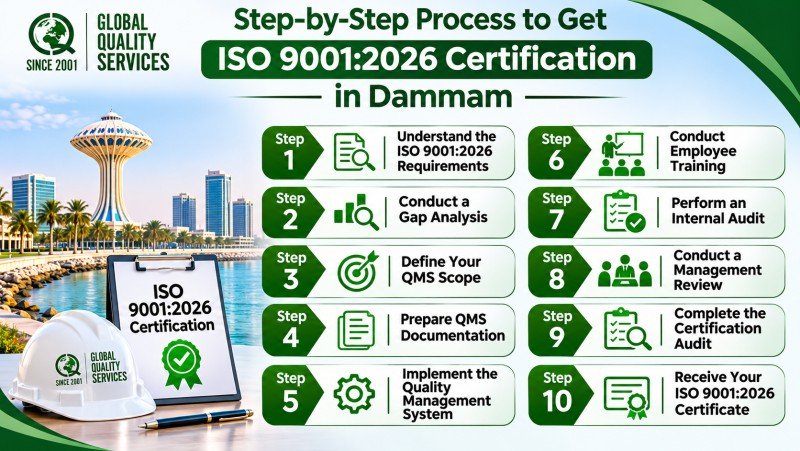
Getting certified requires more than preparing documents. Your organisation must implement the QMS, train employees, monitor processes, and demonstrate compliance during the certification audit.
Follow these steps to prepare for certification.
Step 1: Understand the ISO 9001:2026 Requirements
Start by reviewing the updated standard and identifying its requirements. Understand how they apply to your business activities, products, services, customer expectations, and existing quality management practices.
Step 2: Conduct a Gap Analysis
Compare your existing quality management practices with the new standard. Identify missing procedures, documentation gaps, operational weaknesses, and areas requiring improvement. A gap analysis helps you prepare a practical implementation plan.
Step 3: Define Your QMS Scope
Determine which departments, locations, products, and services your Quality Management System will cover. Define organisational boundaries clearly and consider relevant internal and external issues affecting your operations.
Step 4: Prepare QMS Documentation
Develop the documents and records your organisation needs to demonstrate effective quality management. These may include quality policies, process procedures, work instructions, risk assessments, objectives, and performance records.
Step 5: Implement the Quality Management System
Put the documented procedures into practice across relevant departments. Assign responsibilities, communicate process requirements, monitor activities, and encourage employees to follow the established quality controls.
Step 6: Conduct Employee Training
Train employees according to their roles and responsibilities. Explain the quality policy, operational procedures, and process controls. Make sure employees understand how their work contributes to customer satisfaction and business quality objectives.
Step 7: Perform an Internal Audit
Conduct an internal audit to check whether your QMS meets the applicable ISO 9001:2026 requirements. Review records, interview employees, inspect processes, and identify nonconformities that require corrective action.
Step 8: Conduct a Management Review
Present audit findings, quality performance results, customer feedback, and improvement opportunities to top management. Management should evaluate QMS effectiveness and decide which actions the organisation needs to take.
Step 9: Complete the Certification Audit
Select an accredited certification body to conduct the external audit. The auditors will review your documentation and implementation. They may also visit your facility to assess operational practices and employee awareness.
Step 10: Receive Your ISO 9001:2026 Certificate
Once your organisation meets the certification requirements and closes any required nonconformities, the certification body can issue your certificate. Continue monitoring your QMS and prepare for surveillance audits.
Benefits of ISO 9001:2026 Certification in Dammam
ISO 9001:2026 certification can deliver practical improvements across your organisation. Its value goes beyond receiving an internationally recognised certificate.
Here are some important benefits:
1. Better Product and Service Quality
Consistent process controls help your team identify defects and reduce errors. Your organisation can monitor quality at different stages and take corrective action when performance falls below expectations.
2. Higher Customer Satisfaction
Understanding customer requirements helps your business deliver products and services that meet expectations. Regular feedback and performance reviews also help you address complaints and improve customer relationships.
3. Improved Employee Accountability
Clearly defined responsibilities help employees understand their roles. They can follow established procedures, report problems, and contribute to quality improvement across different departments.
4. Reduced Operational Waste
Better process monitoring helps businesses identify unnecessary activities, repeated work, and resource wastage. Your organisation can improve efficiency while maintaining consistent quality standards.
5. Stronger Market Reputation
ISO 9001 certification demonstrates your organisation’s commitment to quality management. It can strengthen customer confidence and help your business build credibility with suppliers, clients, and potential partners.
6. Better Business Decisions
Performance monitoring gives management useful information about process effectiveness and customer satisfaction. Your organisation can use this information to set priorities and make informed improvement decisions.
7. Greater Business Opportunities
Many organisations consider quality management practices when selecting suppliers and business partners. ISO 9001 certification can strengthen your credentials when pursuing commercial contracts and supply chain opportunities.
Why Choose Global Quality Services for ISO 9001:2026 Certification in Dammam?
Preparing for ISO 9001:2026 certification requires a clear understanding of the standard and your organisation’s operations. Global Quality Services (GQS) supports businesses throughout the certification preparation process.
We focus on practical guidance that helps your team understand requirements and implement a suitable Quality Management System.
Here is how GQS can support your organisation:
- Gap Analysis: We assess your existing QMS and identify areas that need attention.
- Documentation Support: We help prepare relevant quality policies, procedures, and records.
- Implementation Guidance: We guide your team in applying quality controls across business operations.
- Employee Training: We help employees understand their responsibilities and relevant standard requirements.
- Internal Audit Support: We help identify nonconformities and prepare your organisation for external audits.
- Certification Audit Preparation: We guide your team through the final preparation stages.
GQS focuses on your business requirements rather than recommending unnecessary procedures. Our consultants help organisations prepare for certification with a structured and practical approach.
Speak with Global Quality Services for ISO 9001:2026 Certification in Dammam
Ready to improve your quality management practices? Partner with Global Quality Services for expert ISO 9001:2026 consulting support in Dammam. Our consultants can help you understand the updated requirements, identify gaps, prepare documentation, and strengthen your QMS. Contact Global Quality Services to discuss your certification goals and develop an implementation plan that suits your organisation’s operations.
Frequently Asked Questions
1. Can small businesses in Dammam apply for ISO 9001:2026 certification?
Yes. Small businesses can pursue certification regardless of their size. They must establish a suitable QMS that addresses their operations, customer requirements, and applicable standard requirements.
2. How long does it take to prepare for ISO 9001:2026 certification?
The timeline depends on your organisation’s size, existing quality practices, documentation, and employee readiness. A gap analysis helps estimate the preparation time accurately.
3. Does ISO 9001:2026 certification require employee training?
Yes. Employees should understand relevant quality procedures, responsibilities, and operational controls. Training helps teams follow consistent practices and contribute to continual improvement.
4. Can an organisation integrate ISO 9001:2026 with other ISO standards?
Yes. Organisations can integrate their QMS with standards such as ISO 14001 and ISO 45001. This approach helps coordinate management processes and reduce documentation duplication.
5. What happens if auditors identify nonconformities during certification?
Your organisation must address identified nonconformities through corrective actions. The certification body reviews the evidence before making its certification decision.