What is ISO/IEC 17020:2026 Accreditation
ISO/IEC 17020 is an international standard that specifies requirements for the competence of bodies performing inspection activities. It also addresses their impartiality and consistent operation.
The standard applies to different types of inspection bodies, including organisations that inspect equipment, machinery, industrial facilities, products, and processes.
It classifies inspection bodies into three types:
- Type A: Independent third-party inspection bodies that maintain strict independence from the activities they inspect.
- Type B: Inspection bodies that operate as identifiable parts of organisations and provide inspection services to their parent organisation.
- Type C: Inspection bodies that may perform inspections for their parent organisation and external clients, subject to impartiality requirements.
For inspection companies in Jubail, accreditation demonstrates that qualified personnel follow established procedures and use appropriate inspection methods. It also builds confidence among customers, business partners, and regulatory stakeholders.
Why is ISO/IEC 17020:2026 Accreditation Important for Businesses in Jubail
Jubail has a strong industrial base, with major activities across petrochemicals, oil and gas, manufacturing, and infrastructure. Inspection bodies serving these sectors must demonstrate technical competence and impartiality.
Here is how ISO/IEC 17020 accreditation can support your organisation.
1. Demonstrates Inspection Competence
Accreditation demonstrates that your inspection body has qualified personnel, suitable equipment, and documented inspection procedures. Clients can assess your ability to perform inspections against defined requirements.
2. Builds Client Confidence
Industrial clients want reliable inspection results before accepting equipment, materials, or completed work. Accreditation strengthens confidence in your inspection reports and professional capabilities.
3. Supports Regulatory and Industry Requirements
Many industrial projects expect inspection bodies to demonstrate recognised competence. Accreditation can help your organisation meet applicable client, contractual, and regulatory expectations.
4. Improves Inspection Consistency
Documented procedures help inspectors follow consistent methods across different assignments. Your team can reduce variations in inspection activities and maintain reliable records.
5. Strengthens Market Opportunities
Accreditation can help your inspection business compete for contracts that require independent and technically competent inspection services. It also strengthens your professional reputation among industrial clients.
6. Improves Impartiality and Transparency
The standard addresses risks that could influence inspection decisions. Your organisation can establish clear responsibilities and manage potential conflicts of interest.
Key Changes in the ISO/IEC 17020:2026 Edition
The 2026 edition introduces important changes that inspection bodies should understand before applying for accreditation.
Some notable changes include:
- Revised independence classification: The previous Type A, B, and C categories have changed to Type A and Type non-A.
- Risk-based approach: The revised standard gives greater attention to identifying and addressing risks and opportunities.
- Data and information control: Inspection bodies must address requirements for protecting and controlling inspection-related information.
- Greater operational flexibility: The standard places more emphasis on performance-based requirements and gives organisations flexibility in managing their processes.
- Updated organisational responsibilities: Inspection bodies should review their responsibilities and operational arrangements against the revised requirements.
ISO published the third edition on 27 March 2026. The transition period runs for three years from publication, subject to the applicable accreditation body’s transition arrangements.
Step-by-Step Process to Get ISO/IEC 17020:2026 Accreditation in Jubail
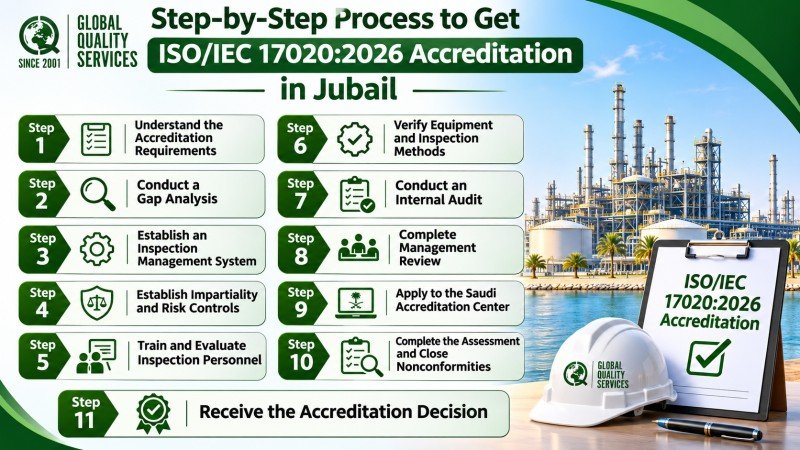
Obtaining accreditation requires more than preparing documents. Your inspection body must demonstrate technical competence through its actual operations, personnel, equipment, and inspection activities.
Follow these steps to prepare.
Step 1: Understand the Accreditation Requirements
Start by studying ISO/IEC 17020:2026 and identifying the requirements that apply to your inspection activities. Define your inspection scope and understand the applicable independence classification.
Step 2: Conduct a Gap Analysis
Review your existing inspection procedures, organisational structure, personnel qualifications, equipment, and records. Identify gaps between your current practices and the revised standard. Prepare an action plan to address them.
Step 3: Establish an Inspection Management System
Develop documented procedures for inspection planning, execution, reporting, record management, and complaint handling. Assign responsibilities and establish controls that support impartiality and consistent inspection results.
Step 4: Establish Impartiality and Risk Controls
Identify potential conflicts of interest that could influence inspection decisions. Evaluate operational risks and establish suitable controls. Maintain clear responsibilities between inspection activities and other business operations.
Step 5: Train and Evaluate Inspection Personnel
Your inspectors must understand the relevant inspection methods, technical requirements, and reporting procedures. Provide appropriate training and evaluate their competence through practical assessments and documented records.
Step 6: Verify Equipment and Inspection Methods
Check whether your inspection equipment suits the activities within your proposed scope. Maintain calibration or verification records where applicable. Validate inspection methods and establish controls for equipment maintenance.
Step 7: Conduct an Internal Audit
Review your inspection management system against ISO/IEC 17020:2026. Check whether employees follow documented procedures and maintain appropriate records. Record audit findings and address identified nonconformities.
Step 8: Complete Management Review
Management should evaluate audit results, customer feedback, complaints, operational performance, risks, and improvement opportunities. Record decisions and assign responsibilities for completing agreed actions.
Step 9: Apply to the Saudi Accreditation Center
Submit your accreditation application to the Saudi Accreditation Center (SAAC), along with the required documents and proposed scope. SAAC reviews the application and proceeds with the applicable assessment stages.
Step 10: Complete the Assessment and Close Nonconformities
Prepare your team for document review and on-site assessment. The assessment team evaluates your technical competence and implementation. Address any nonconformities and submit corrective action evidence for review.
Step 11: Receive the Accreditation Decision
SAAC reviews the assessment results and corrective actions before making its accreditation decision. Once approved, your inspection body receives accreditation for the specific scope granted.
Why Choose Global Quality Services (GQS) for ISO/IEC 17020:2026 Accreditation in Jubail?
Preparing for accreditation can become challenging when your team handles technical operations alongside documentation and assessment requirements. Global Quality Services helps inspection bodies organise their preparation and understand the requirements.
Here is how GQS can support your accreditation journey:
1. Practical Gap Assessment
GQS can review your existing inspection practices and identify areas that need attention. This helps your team focus on relevant improvements before the formal assessment.
2. Documentation Support
Our consultants can assist with preparing and reviewing inspection procedures, policies, records, and other required documentation based on your organisation’s activities.
3. Impartiality and Risk Management Guidance
GQS can help you identify potential conflicts of interest and develop suitable controls. This supports transparent inspection decisions and clear organisational responsibilities.
4. Employee Training Support
Your inspectors and management team need to understand their responsibilities. GQS can support training activities to improve awareness of accreditation requirements and inspection procedures.
5. Internal Audit Assistance
GQS can help your organisation review its implementation, identify nonconformities, and prepare corrective action plans before the external assessment.
6. Assessment Preparation
Our consultants can guide your team through documentation reviews, assessment preparation, and corrective action follow-up. This helps you approach the accreditation process with greater clarity.
Speak with GQS for ISO/IEC 17020:2026 Accreditation in Jubail
Are you preparing your inspection body for ISO/IEC 17020:2026 accreditation in Jubail? Global Quality Services can help you understand the revised requirements, identify compliance gaps, prepare documentation, and train your employees. Our consultants work with your team throughout the preparation process. Contact Global Quality Services today to discuss your inspection activities and take the next step towards accreditation.
Frequently Asked Questions
1. Which industries in Jubail can benefit from ISO/IEC 17020:2026 accreditation?
Oil and gas, petrochemical, construction, manufacturing, and equipment inspection businesses can benefit. Accreditation demonstrates their competence to perform inspections within an approved scope.
2. Can an inspection body apply for accreditation if it outsources certain inspection activities?
Yes, but the inspection body must maintain appropriate controls over outsourced activities. It must evaluate external providers and retain responsibility for applicable inspection requirements.
3. What documents should an inspection body prepare before applying?
Prepare your organisational structure, inspection procedures, personnel competence records, equipment details, impartiality arrangements, internal audit reports, and management review records.
4. Does ISO/IEC 17020:2026 accreditation cover every inspection activity?
No. Accreditation applies to the specific inspection activities included in the approved scope. Your organisation must demonstrate competence for each activity it wants accredited.
5. Can an inspection body expand its accreditation scope later?
Yes. An accredited inspection body can apply to extend its scope. The accreditation body evaluates the additional activities before approving any changes.